Get a Free Quote

Our representative will contact you soon.
Email
Mobile/WhatsApp
Name
Company Name
Message
0/1000

CISCO

All Categorys

Server
Storage
Network Security
Workstation
Parts
Software

All Small Categorys

Server
Storage
Network Security
Workstation
Parts
Software

Cisco Nexus 9300-FX2 Series Switches

Product overview

The Cisco Nexus® 9300-FX2 Series switches belongs to the fixed Cisco Nexus 9000 platform based on Cisco Cloud Scale technology.The platform support cost-effective cloud-scale deployments, an increased number of endpoints, and cloud services with wire-rate security and telemetry. The platform is built on modern system architecture designed to provide high performance and meet the evolving needs of highly scalable data centers and growing enterprises.

Cisco Nexus 9300-FX2 series is an extension of Nexus 9300-FX series switches with higher bandwidth capacity. The switches offer a variety of interface options to transparently migrate existing data centers from 1-Gbps, and 10-Gbps speeds to 25- Gbps at the server, and from 10- and 40-Gbps speeds to 50- and 100- Gbps at the aggregation layer. The platforms provide investment protection for customers, delivering large buffers, highly flexible Layer 2 and Layer 3 scalability, and performance to meet the changing needs of virtualized data centers and automated cloud environments.

Cisco provides two modes of operation for Cisco Nexus 9000 Series Switches. Organizations can use Cisco NX-OS Software to deploy the switches in standard Cisco Nexus switch environments (NX-OS mode). Organizations can also deploy the infrastructure that is ready to support the Cisco Application Centric Infrastructure (Cisco ACI™) platform to take full advantage of an automated, policy-based, systems-management approach (ACI mode).
  • Description
  • Features and benefits

Product overview

The Cisco Nexus® 9300-FX2 Series switches belongs to the fixed Cisco Nexus 9000 platform based on Cisco Cloud Scale technology.The platform support cost-effective cloud-scale deployments, an increased number of endpoints, and cloud services with wire-rate security and telemetry. The platform is built on modern system architecture designed to provide high performance and meet the evolving needs of highly scalable data centers and growing enterprises.

Cisco Nexus 9300-FX2 series is an extension of Nexus 9300-FX series switches with higher bandwidth capacity. The switches offer a variety of interface options to transparently migrate existing data centers from 1-Gbps, and 10-Gbps speeds to 25- Gbps at the server, and from 10- and 40-Gbps speeds to 50- and 100- Gbps at the aggregation layer. The platforms provide investment protection for customers, delivering large buffers, highly flexible Layer 2 and Layer 3 scalability, and performance to meet the changing needs of virtualized data centers and automated cloud environments.

Cisco provides two modes of operation for Cisco Nexus 9000 Series Switches. Organizations can use Cisco NX-OS Software to deploy the switches in standard Cisco Nexus switch environments (NX-OS mode). Organizations can also deploy the infrastructure that is ready to support the Cisco Application Centric Infrastructure (Cisco ACI™) platform to take full advantage of an automated, policy-based, systems-management approach (ACI mode).

Switch models

Table 1. Cisco Nexus 9300-FX2 Series Switches
Model
Description
Cisco Nexus 9336C-FX2
36 x 40/100-Gbps QSFP28 ports
Cisco Nexus 9336C-FX2-E
36 x 40/100-Gbps QSFP28 ports
Cisco Nexus 93240YC-FX2
48 x 1/10/25-Gbps fiber ports and 12 x 40/100-Gbps QSFP28 ports
Cisco Nexus 93360YC-FX2
96 x 1/10/25-Gbps fiber ports and 12 x 40/100-Gbps QSFP28 ports
Cisco Nexus 93216TC-FX2
96 x 100M/1/10GBASE-T ports and 12 x 40/100-Gigabit QSFP28 ports
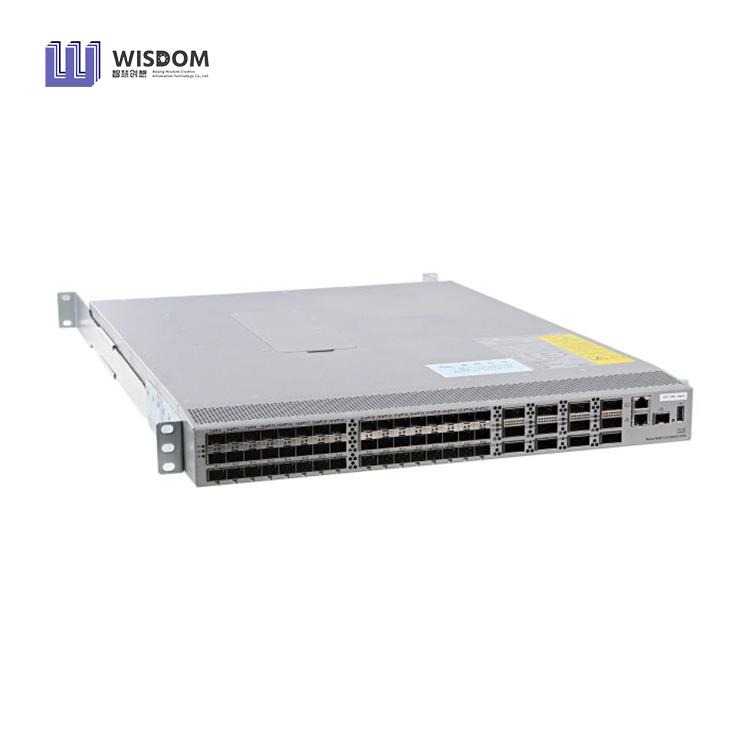
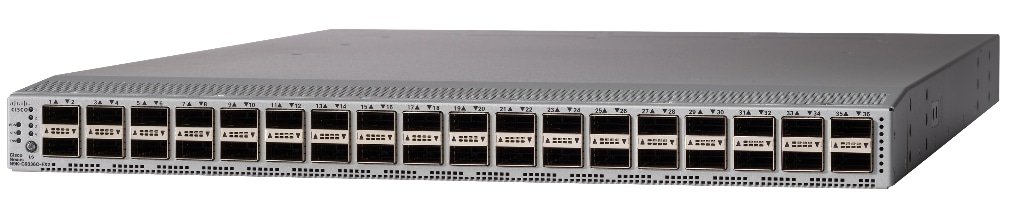
The Cisco Nexus 9336C-FX2 Switch (Figure 1) is a 1RU switch that supports 7.2 Tbps of bandwidth and over 2.4 bpps. The switch can be configured to work as 1/10/25/40/50/100-Gbps offering flexible options in a compact form factor. Breakout is supported on all ports. Please see feature table below for more information.
Cisco_Nexus_9300-FX2 (1).jpg
Figure 1. Cisco Nexus 9336C-FX2 Switch
The Cisco Nexus 9336C-FX2-E Switch (Figure 2) is a 1RU switch that supports 7.2 Tbps of bandwidth and over 2.4 bpps. The switch can be configured to work as 1/10/25/40/50/100-Gbps or as 16-, 32-Gbps Fibre Channel ports[2] offering flexible options in a compact form factor. Breakout is supported on all ports. Please see feature table below for more information.
Cisco_Nexus_9300-FX2 (5).png
Figure 2. Cisco Nexus 9336C-FX2-E Switch
The Cisco Nexus 93240YC-FX2 Switch (Figure 3) is a 1.2RU switch that supports 4.8 Tbps of bandwidth and over 2.5bpps. The 48 ports of downlinks support 1/10/25-Gbps. The 12 uplinks ports can be configured as 40- and 100-Gbps ports, offering flexible migration options. The switch is ideal for a non-oversubscribed solution in a compact form factor. The switch has FC-FEC and RS-FEC enabled for 25Gbps support over longer distances.
Cisco_Nexus_9300-FX2 (2).jpg
Figure 3. Cisco Nexus 93240YC-FX2 Switch
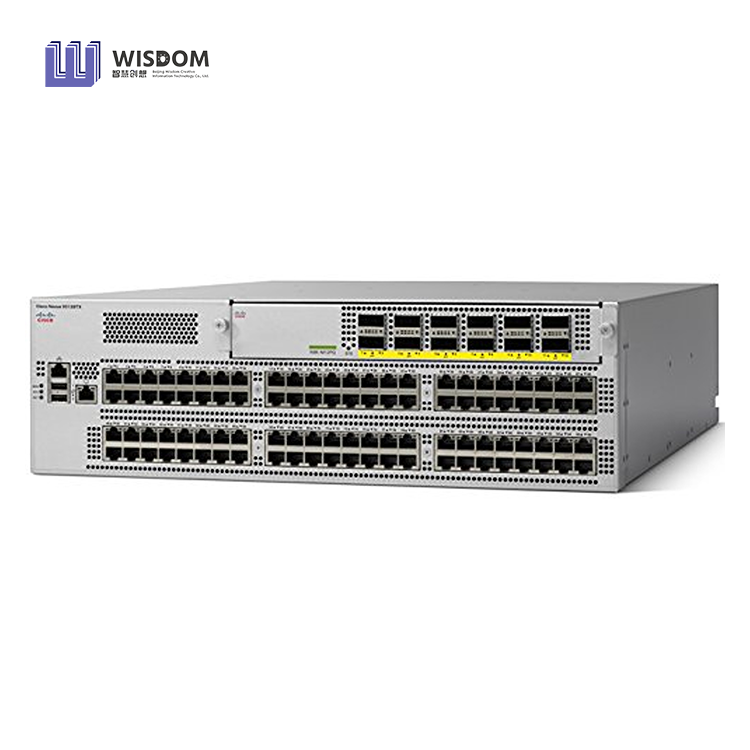
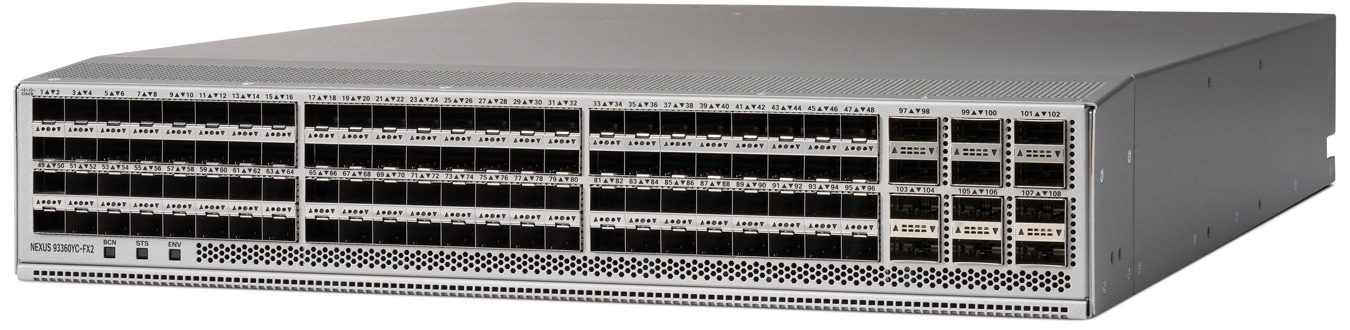
The Cisco Nexus 93360YC-FX2 Leaf Switch is an 2-Rack-Unit (2RU) Leaf switch that supports 7.2 Tbps of bandwidth and 2.4 bpps across 96 fixed 10/25G SFP+ ports and 12 fixed 40/100G QSFP28 ports (Figure 3). The 96 ports of downlinks support 1/10/25-Gbps.The 12 uplinks ports can be configured as 40- and 100-Gbps ports, offering flexible migration options. The switch has FC-FEC and RS-FEC enabled for 25Gbps support over longer distances. Please see feature table below for more information.
Cisco_Nexus_9300-FX2 (3).jpg
Figure 4. Cisco Nexus 93360YC-FX2 Switch
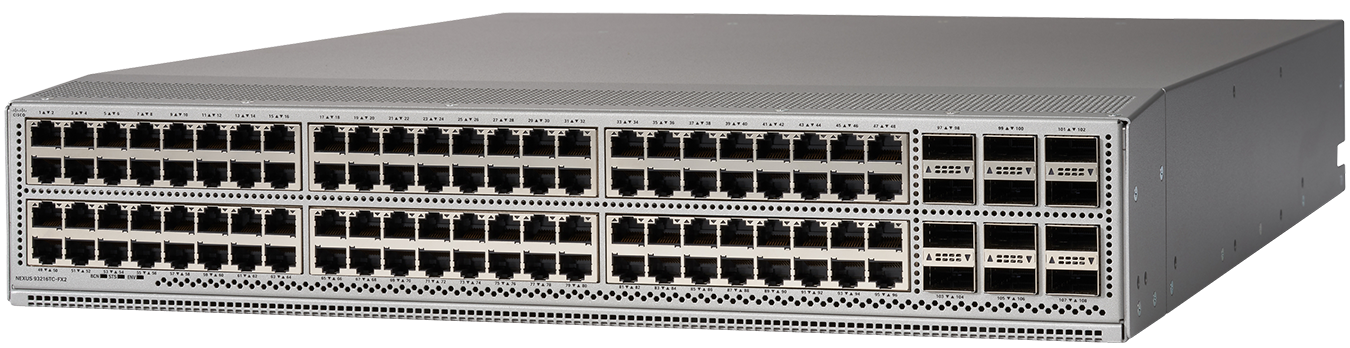
The Cisco Nexus 93216TC-FX2 Switch (Figure 5) is a 2RU switch that supports 4.32 Tbps of bandwidth and over 2.5bpps. The 96 10GBASE-T downlink ports on the 93216TC-FX2 can be configured to work as 100-Mbps, 1-Gbps, or 10-Gbps ports. The 12 uplinks ports can be configured as 40- and 100-Gbps ports, offering flexible migration options.
Cisco_Nexus_9300-FX2 (6).png
Figure 5. Cisco Nexus 93216TC-FX2 Switch
The Cisco Nexus 9300-FX2 series provide the following features and benefits:

Architectural Flexibility
◦ Industry leading Software Defined Networking Solution Cisco ACI™support.
◦ Support for standards based VXLAN EVPN fabrics, inclusive of hierarchical multi-site support (refer to VXLAN Network with MP-BGP EVPN Control Plane for more information).
◦ Three-tier BGP architectures, enabling horizontal, non-blocking IPv6 network fabrics at web-scale.
◦ Segment routing allows the network to forward Multiprotocol Label Switching (MPLS) packets and engineer traffic without Resource Reservation Protocol (RSVP) Traffic Engineering (TE). It provides a control-plane alternative for increased network scalability and virtualization.
◦ Comprehensive protocol support for Layer 3 (v4/v6) unicast and multicast routing protocol suites, including BGP, Open Shortest Path First (OSPF), Interior System to Interior System (IS-IS), Enhanced Interior Gateway Routing Protocol (EIGRP), Routing Information Protocol Version 2 (RIPv2), Protocol Independent Multicast Sparse Mode (PIM-SM), Source-Specific Multicast (SSM), and Multicast Source Discovery Protocol (MSDP).

Extensive Programmability
◦ Day zero automation through Power On Auto Provisioning, drastically reducing provisioning time.
◦ Industry leading integrations for leading develops configuration management applications – Ansible, Chef, Puppet, SALT.Extensive Native YANG and industry standard OpenConfig model support through RESTCONF/NETCONF.
◦ Pervasive API’s for all switch CLI functions (JSON based RPC over HTTP/HTTPs).

High Scalability, flexibility, and security
◦ Flexible forwarding tables support up to 1 million shared entries on FX2 models. Flexible use of TCAM space allows for custom definition of Access Control List (ACL) templates.
◦ IEEE 802.1ae MAC Security (MACsec[1]) support on all ports of 9300-FX2 models with speed greater than or equal to 1-Gbps, allows traffic encryption at the physical layer and provides secure server, border leaf, and leaf-to-spine connectivity.

Intelligent Buffer Management
◦ The platform offers Cisco’s innovative intelligent buffer management, that offers capability to distinguish mice and elephant flows and apply different queue management schemes to them based on their network forwarding requirements in the event of link congestion.
◦ Intelligent buffer management functions are:
◦ Approximate Fair Dropping (AFD) with Elephant Trap (ETRAP). AFD distinguishes long-lived elephant flows from short-lived mice flows, by using ETRAP. AFD exempts mice flows from the dropping algorithm so that mice flows will get their fair share of bandwidth without being starved by bandwidth-hungry elephant flows. Also, AFD tracks elephant flows and subjects them to the AFD algorithm in the egress queue to grant them their fair share of bandwidth.
◦ ETRAP measures the byte counts of incoming flows and compares this against the user defined ETRAP threshold. After a flow crosses the threshold, it becomes an elephant flow.
◦ Dynamic Packet Prioritization (DPP) provides the capability of separating mice flows and elephant flows into two different queues so that buffer space can be allocated to them independently. Mice flows, sensitive to congestion and latency can take priority queue and avoid re-ordering that allows to elephant flows to take full link bandwidth.

RDMA over Converged Ethernet – RoCE support
◦ Platform offers lossless transport for RDMA over Converged Ethernet with support of DCB protocols:
◦ Priority-based Flow Control – (PFC) to prevent drops in the network and pause frame propagation per priority class.
◦ Enhanced Transmission Selection – (ETS) to reserve bandwidth per priority class in network contention situation.
◦ Data Center Bridging Exchange Protocol – (DCBX) to discover and exchange priority and bandwidth information with end points.
◦ Platform also supports Explicit Congestion Notification – (ECN) that provides end-to-end notification per IP flow by marking packets that experienced congestion, without dropping traffic. The platform is capable to track ECN statistics of number of marked packet that have experienced congestion.

LAN and SAN Convergence
◦ Fibre Channel and Fibre Channel over Ethernet (FCoE) N-Port Virtualization (NPV) support enables the network administrator to control domain IDs and points of management on a Fibre Channel network as it scales. This feature enables LAN and SAN converged networks on a lossless, reliable Ethernet network.

Hardware and software high availability
◦ Virtual Port-Channel (vPC) technology provides Layer 2 multipathing through the elimination of Spanning Tree Protocol. It also enables fully utilized bisectional bandwidth and simplified Layer 2 logical topologies without the need to change the existing management and deployment models.
◦ The 64-way Equal-Cost MultiPath (ECMP) routing enables the use of Layer 3 fat-tree designs. This feature helps organizations prevent network bottlenecks, increase resiliency, and add capacity with little network disruption.
◦ Advanced reboot capabilities include hot and cold patching.
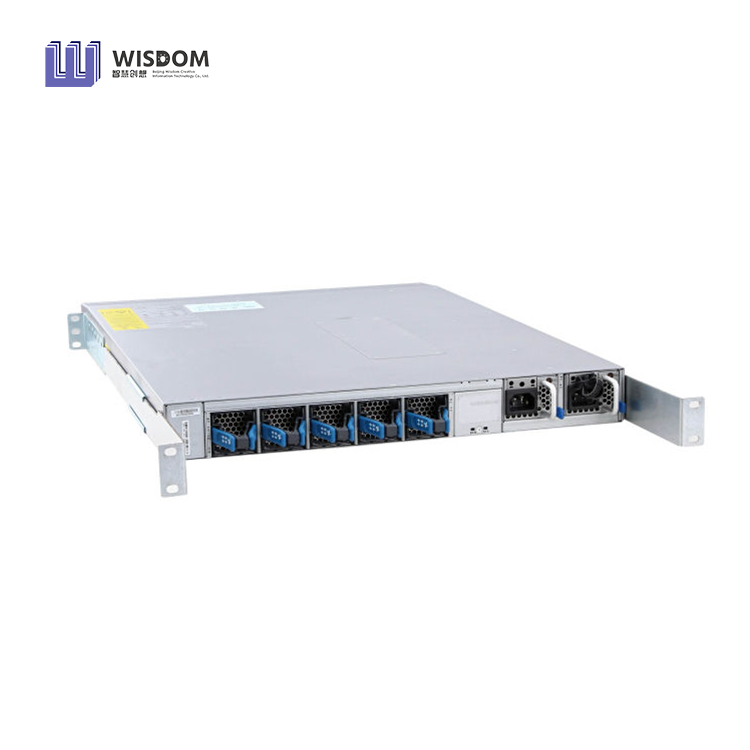
◦ The switches use hot-swappable Power-Supply Units (PSUs) and fans with N+1 redundancy.

Purpose-built Cisco NX-OS Software operating system with comprehensive, proven innovations
◦ Single binary image that supports every switch in the Cisco Nexus 9000 series, simplifying image management. The operating system is modular, with a dedicated process for each routing protocol: a design that isolates faults while increasing availability. In the event of a process failure, the process can be restarted without loss of state. The operating system supports hot and cold patching and online diagnostics.
◦ Data Center Network Manager (DCNM) is the network management platform for all NX-OS-enabled deployments, spanning new fabric architectures, IP Fabric for Media, and storage networking deployments for the Cisco Nexus®-powered data center. Accelerate provisioning from days to minutes, and simplify deployments from day zero through day N. Reduce troubleshooting cycles with graphical operational visibility for topology, network fabric, and infrastructure. Eliminate configuration errors and automate
ongoing change in a closed loop, with templated deployment models and configuration compliance alerting with automatic remediation. Real-time health summary for fabric, devices, and topology. Correlated visibility for fabric (underlay, overlay, virtual and physical endpoints), including compute visualization with VMware.
◦ Network traffic monitoring with Cisco Nexus Data Broker builds simple, scalable, and cost-effective network Test Access Points (TAPs) and Cisco Switched Port Analyzer (SPAN) aggregation for network traffic monitoring and analysis.

Cisco Tetration Analytics platform support
◦ The telemetry information from the Nexus 9300 Series switches is exported every 100 milliseconds by default directly from the switch’s Application-Specific Integrated Circuit (ASIC). This information consists of three types of data: (a) Flow information, this information contains information about endpoints, protocols, ports, when the flow started, how long the flow was active, etc.(b) Inter-packet variation, this information captures any inter-packet variations within the flow. Examples include variation in Time To Live (TTL), IP and TCP flags, payload length, etc. (c) Context details, context information is derived outside the packet header, including variation in buffer utilization, packet drops within a flow, association with tunnel endpoints, etc.
◦ The Cisco Tetration Analytics platform consumes this telemetry data, and by using unsupervised machine learning and behavior analysis it can provide outstanding pervasive visibility across everything in your data center in real time. By using algorithmic approaches, the Cisco Tetration Analytics platform provides a deep application insights and interactions, enabling dramatically simplified operations, a zero-trust model, and migration of applications to any programmable infrastructure.

Cisco Network Assurance Engine (NAE)
◦ Cisco NAE continuously verifies if the network infrastructure is operating as per policy intent and it leverages the power of mathematical models to reason on behalf of the operator in policy, configuration and dynamic state level. NAE can precisely indicate problems in the network, identify which application or part of network is impacted, root-cause the problem and suggest how to fix it. Its continuous verification approach transforms Day 2 Operations from reactive to proactive mode and it does so without using any packet data. NAE helps avoid outages by predicting the impact of changes, reducing network related IT incidents and shrinking the mean time to repair by up to 66%. NAE also helps assure network security and segmentation compliance.

Product specifications

The Cisco Nexus 9300-FX2 series offer industry-leading density and performance with flexible port configurations that can support existing copper and fiber cabling (Table 2).
Table 2. Cisco Nexus 9300-FX2 Series Switches specifications
Feature
Cisco Nexus 9336C-FX2
Cisco Nexus 9336C-FX2-E
Cisco Nexus 93240YC-FX2
Cisco Nexus 93360YC-FX2
Cisco Nexus 93216TC-FX2
Ports
36 x 40/100-Gbps QSFP28 ports
48 x 1/10/25-Gbps and 12 x 40/100-Gbps QSFP28 ports
96 x 1/10/25-Gbps and 12 x 40/100-Gbps QSFP28 ports
96 x 100M/1/10GBASE-T ports and 12 x 40/100-Gbps QSFP28 ports
Supported speeds
1/10/25/40/100-Gbps Ethernet
Breakout supported on all ports, 1-36:
100G, 2x50G NRZ,
40G native, 4x10/25G (10G w/QSA)
1G w/QSA except ports 1-6 and 33-36
1/10/25/40/100-Gbps Ethernet
Breakout supported on all ports, 1-36:
100G, 2x50G NRZ,
40G native, 4x10/25G (10G w/QSA)
1G w/QSA except ports 1-6 and 33-36
1/10/25-Gbps on downlinks
40/100-Gbps on uplinks
1/10/25-Gbps on downlinks
40/100-Gbps on uplinks
Breakout supported ports, 97-108: 4x10/25G
100M/1/10 Gbps RJ45 downlinks
40/100-Gbps on uplinks
Breakout supported ports, 97-108: 4x10/25G
FC/FCoE
N/A
16/32-Gbps Fiber Channel
N/A
16/32-Gbps Fiber Channel
N/A
CPU
4 cores
4 cores
4 cores
4 cores
4 cores
System memory
24 GB
24 GB
Upto 24 GB
Upto 24 GB
Upto 24 GB
SSD drive
128 GB
128 GB
128 GB
128 GB
128 GB
System buffer
40 MB
40 MB
40 MB
40 MB
40 MB
Management ports
2 ports: 1 RJ-45 and 1 SFP+
USB ports
1
1
1
1
1
RS-232 serial ports
1
1
1
1
1
Power supplies
(up to 2)
750W AC2, 1100W AC, 1100W DC, 1100W HVAC/HVDC
1100W AC, 1100W DC, 1100W HVAC/HVDC
750W AC2, 1100W AC, 1100W DC, 1100W HVAC/HVDC
1200W AC, 930W DC, 1200W HVAC/HVDC
Typical power (AC)
337W
337W
298W
404W
580W
Maximum power (AC)
719W
705W
708W
900W
965W
Input voltage (AC)
100 to 240V
100 to 240V
100 to 240V
100 to 240V
100 to 240V
Input voltage (High-Voltage AC [HVAC])
100 to 277V
100 to 277V
100 to 277V
100 to 277V
100 to 277V
Input voltage (DC)
–40 to –72V
–40 to –72V
–40 to –72V
–40V to –72V
–40V to –72V
Input voltage (High-Voltage DC [HVDC])
–240 to –380V
–240 to –380V
–240 to –380V
–240V to –380V
–240V to –380V
Frequency (AC)
50 to 60 Hz
50 to 60 Hz
50 to 60 Hz
50 to 60 Hz
50 to 60 Hz
Fans
3 dual fan trays
6
5
3 fan trays
3 fan trays
Airflow
Port-side intake and exhaust
Physical dimensions
(H x W x D)
1.72 x 17.3 x 24.5 in. (4.4 x 43.9 x 62.3 cm)
1.72 x 17.3 x 24.7 in. (4.4 x 43.9 x 62.7 cm)
2.1 x 17.3 x 23.3 in. (5.3 x 43.9 x 59.1 cm)
3.38 x 17.41 x 24.14in. (8.59 x 44.23 x 61.31 cm)
3.38 x 17.41 x 23.6 in (8.59 x 44.2 x 59.9 cm)
Acoustics
76.2 dBA at 50% fan speed, 85.3 dBA at 70% fan speed, and 92.3 dBA at 100% fan speed
74.7 dBA at 50% fan speed, 80.4 dBA at 70% fan speed, and 88.1 dBA at 100% fan speed
76.4 dBA at 50% fan speed, 83.3 dBA at 70% fan speed, and 92.1 dBA at 100% fan speed
76.7 dBA at 40% fan speed, 88.7 dBA at 70% Fan speed and 97.4 dBA at 100% Fan speed
RoHS compliance
Yes
Yes
Yes
Yes
Yes
MTBF
335,900 hours
330,810 hours
345,950 hours
318,030 hours
267,560 hours
Minimum ACI image
ACI-N9KDK9-13.1.2
ACI-N9KDK9-14.0
ACI-N9KDK9-14.1.2
ACI-N9KDK9-14.1.2
Minimum NX-OS image
NXOS-703I7.3
NXOS-10.1(1)
NXOS-703I7.3
NXOS-9.3(1)
NXOS-9.3(1)

Get a Free Quote

Our representative will contact you soon.
Email
Mobile/WhatsApp
Name
Company Name
Message
0/1000

Get a Free Quote

Our representative will contact you soon.
Email
Mobile/WhatsApp
Name
Company Name
Message
0/1000

微信图标
cisco nexus 9300 fx2 series switches-3